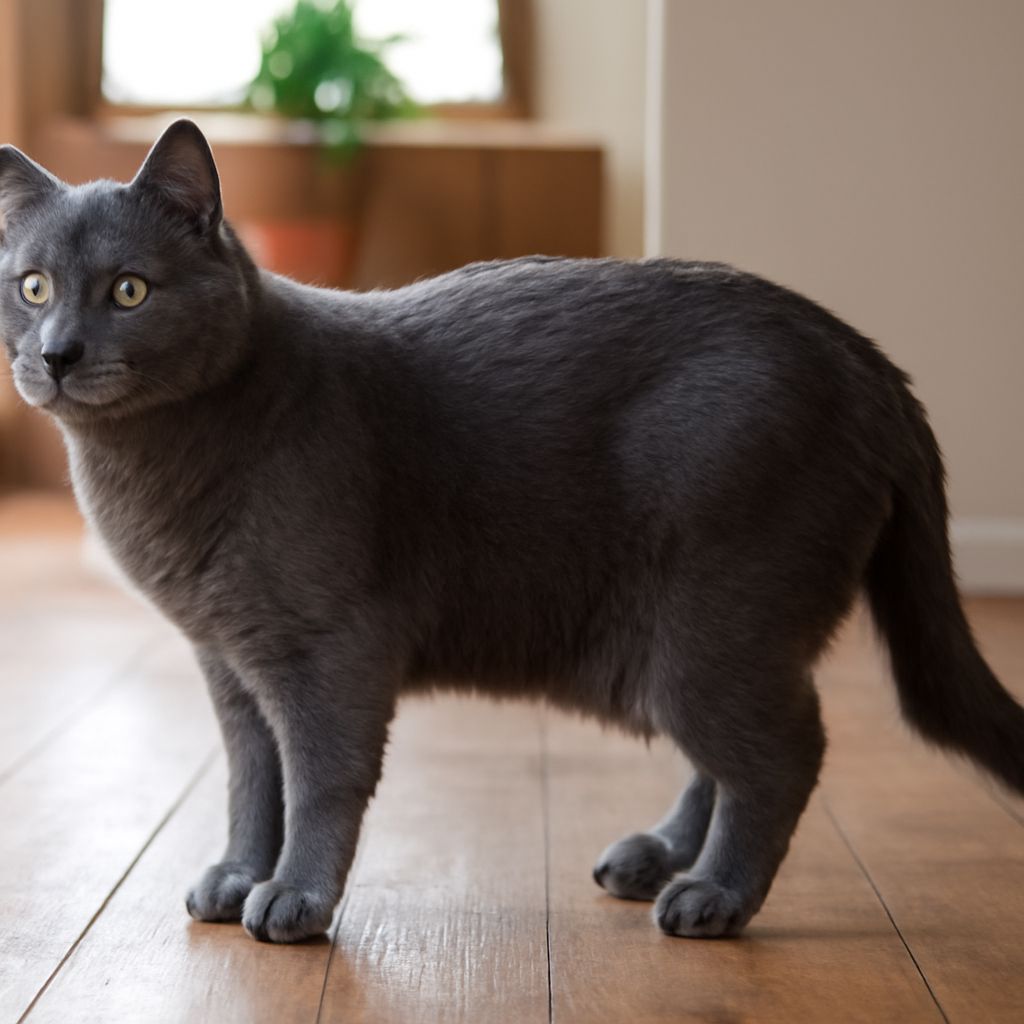

You meet a cat at a shelter and notice a distinctive silhouette. Is this cat without a tail a Manx, and does that shape mean they will need special care? Cats born without tails can have different histories, so start with the individual animal and a closer look at their health.
Cats without tails: what the description means
“Tailless” describes appearance: there is no visible tail, or at most a very small rise at the rump. A tailless cat may have been born that way, but a short or absent tail can also be the result of an injury or surgery. Those histories call for different questions, even when two cats look much alike.
For cats with no tails, ask the shelter, previous caretaker or breeder what they know about the cat’s birth, any accident and any treatment. Request veterinary records and ask about walking, litter-box habits and discomfort around the hindquarters. If the history is unknown, a veterinarian can examine the cat and explain what further information or testing might help. For an animal with an unknown history, a photograph alone cannot establish the cause.
Not all cats without tails belong to the same breed. A missing tail does not establish a Manx pedigree, just as a round face does not provide a family tree. Breed records and known ancestry are more informative than appearance alone. Cats without tails can also have mixed ancestry. A tailless cat may have no known pedigree at all.
Why Manx tails vary
The International Cat Association (TICA) describes a naturally occurring mutation associated with the Manx’s shortened tail. The tail is part of the spine, made up of small bones called vertebrae. Development varies: some kittens have no visible tail, some have a short stump, and others have a full-length tail.
That means a Manx cat with a tail fits the breed’s broader family picture. TICA describes both short and full-length tails in the breed, and separately lists Manx Tailed. A tailed Manx cat is still worth discussing on their own terms: ask for their history and health records, rather than judging their needs by length alone.
You may hear informal names such as “rumpy” for an animal with no visible tail and “stumpy” for one with a short tail. These words describe what someone sees; they are not a veterinary assessment. Nor can a tail on a Manx cat tell you, by itself, exactly how the rest of the spine developed.
If you are considering Manx cats with tails, ask the same questions you would ask about any prospective companion: how they move, use the litter box, respond to handling and have been cared for. A Manx with a full-length tail can have individual health needs, just as any other cat can. Your veterinarian can help interpret the available history.
The health connection to understand
The inherited changes associated with the Manx body type can involve more than tail length. The Merck Veterinary Manual describes spinal developmental problems in some affected Manx cats, including spina bifida, in which the spine does not close normally during development. Depending on the structures involved, signs can include weakness in the rear legs or difficulty controlling urination or defecation.
This is a possibility to take seriously, not a diagnosis for every individual. Some affected cats have no such signs. Others need ongoing veterinary care or changes at home. Outward appearance cannot tell you whether an individual has a spinal or nerve problem, or predict how severe one might be.
Ask a veterinarian what they find on a physical and neurological examination, whether the cat’s history suggests further tests, and what changes should prompt a call. If you are adopting, ask the organization to share known findings and treatments. Make decisions with the cat’s comfort and ability to move and eliminate in mind; an extreme appearance should never be the goal at the expense of welfare.
Tail injury is a different story
A cat that once had a longer tail may have lost part of it after an accident or veterinary surgery. Do not assume a short tail is inherited when the history is uncertain. Ask about the cause, treatment and any remaining limitations. A caretaker may also be able to tell you what the cat’s normal gait and bathroom habits look like.
A new limp tail, wound or pain after a fall or accident deserves veterinary attention. According to VCA Animal Hospitals, a severe pull can damage nerves involved in urination and defecation as well as tail movement. Contact a veterinarian promptly after an injury; a cat hit by a car or badly injured in a fall needs an examination for injuries beyond the tail.
Everyday care and signs to watch
Give a cat with no tail the same basics you would offer any cat: appropriate food, fresh water, a clean litter box, play, a quiet resting place and regular veterinary care. For cats born with this trait, learn their usual way of walking, jumping and using the box. That baseline makes a change easier to describe when you call the clinic.
Handle the hindquarters gently. Support the chest and hind end when lifting, and let the cat come down if they struggle. TICA advises care around the rump or short tail and supporting the hindquarters when carrying a Manx. Ask your veterinarian for a handling demonstration if the cat appears uncomfortable. For a cat with mobility trouble, a low-entry litter box and easy access to favorite resting spots may help; your veterinarian can suggest adaptations for that cat.
Keep an eye on the litter box as well as the cat. Note straining, unusually small urine clumps, accidents, hard stools or a change in how often the box is used. These signs have several possible causes, so report what you see rather than trying to name the condition. A cat that repeatedly strains and produces little or no urine needs immediate veterinary attention: VCA explains that urinary blockage can be life-threatening. Sudden inability to stand or walk also warrants emergency care.
If your cat starts avoiding a familiar jump or leaves stool outside the box, note when it began and call your veterinarian to arrange an examination. Bring the cat’s records and describe the change you observed.