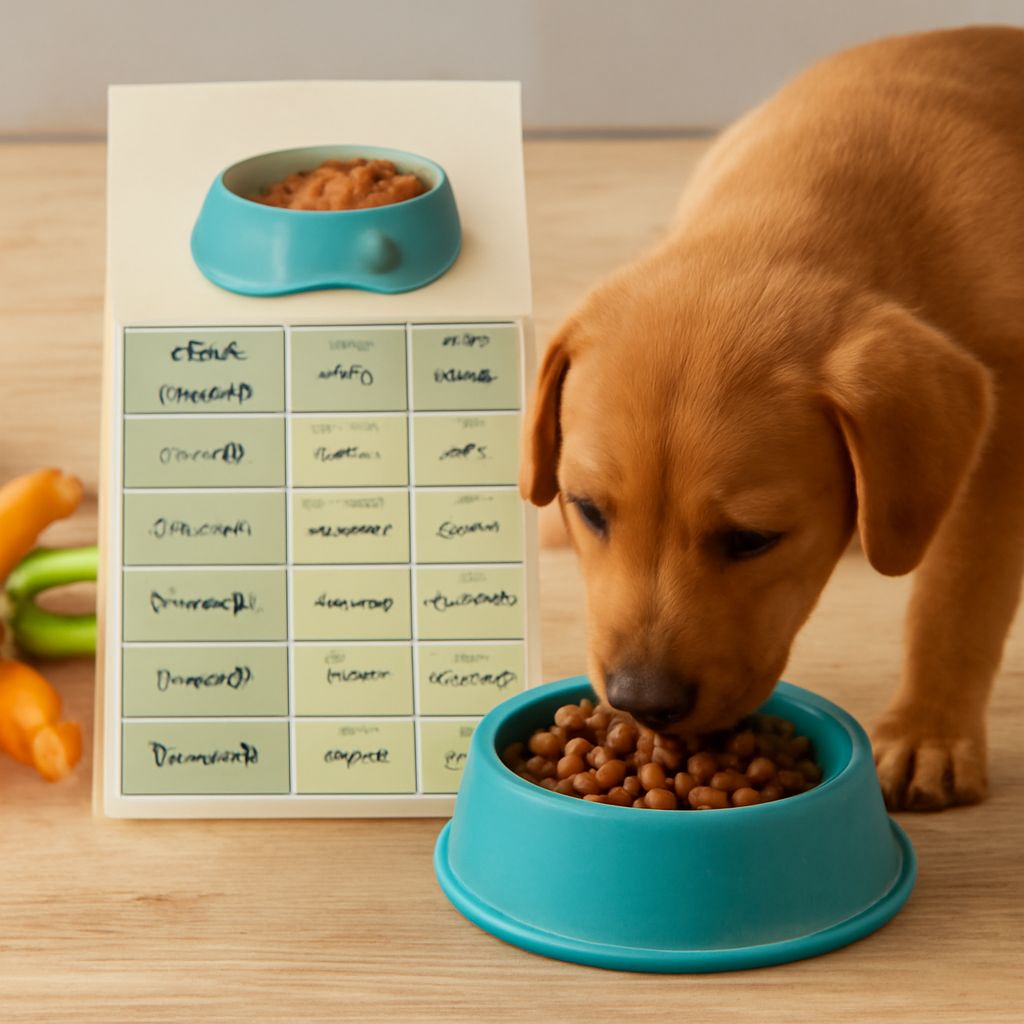

You have a new puppy, a bag of food, and a chart full of numbers. A feeding chart for your puppy can help you find a starting daily amount, but first you need to know what the rows and columns mean.
A chart showing how much food to feed a puppy works only when you use the directions for that particular food. Find the right age and weight categories, check whether the amount is per day, and then divide it into meals. Your veterinarian can help adjust that starting point as your puppy grows.
How Much to Feed a Puppy Chart: An Example
The following example shows the arithmetic, not a recommended ration. Imagine a food’s label gives a hypothetical puppy 1½ cups per day, and its veterinarian recommends three meals. In the How Much to Feed a Puppy chart below, the same daily total is split into equal meals:
| Example meal | Food from daily total |
|---|---|
| Morning | ½ cup |
| Midday | ½ cup |
| Evening | ½ cup |
| Total | 1½ cups per day |
The important word is total. Three meals of ½ cup add up to 1½ cups; they do not mean 1½ cups at each meal. Your own puppy’s daily amount and meal count may be different. Read the package and discuss the schedule with your vet rather than copying this example.
Find the Right Row and Column
A puppy’s feeding chart may use age, weight, or both. First, check that the food is labeled complete and balanced for growth and appropriate for your puppy’s expected adult size. This matters especially for large-breed puppies. The World Small Animal Veterinary Association’s guide to selecting pet food explains how to look for a nutritional adequacy statement and calorie information.
A puppy feeding chart by weight, age, and food type is only useful if you understand each heading. One package may ask for current weight: what your puppy weighs now. Another may use expected adult weight: an estimate of the dog’s future size. If both appear, use each where the label specifies. A 10-pound puppy expected to reach 50 pounds should not be placed in the 10-pound adult-weight column simply because that is today’s scale reading.
If you don’t know the expected adult weight, ask your vet for an estimate and revisit it as your puppy grows. Mixed-breed puppies can be especially hard to predict. Check the age units too: weeks and months are easy to confuse when you’re reading a bag before your first coffee.
A feeding guide for puppies by age and weight may give a range instead of one number. Note the full range, the units, and any instructions for choosing within it. If your puppy falls between categories or the label is unclear, contact the manufacturer or your vet rather than guessing which column was intended.
Measure the Daily Amount, Then Divide It
How much do puppies eat? The answer varies with the particular food, the puppy’s age, size, growth, and health. A cup of one formula can contain a different number of calories from a cup of another. When you change foods, use the new package’s directions rather than carrying the old cup measure across unchanged.
Check whether the label gives a daily total or an amount per meal, and whether the unit is cups, ounces, grams, or cans. If a package provides a weight in grams, a kitchen scale can measure the food more consistently than an overflowing scoop. When a cup measure is specified, use a standard measuring cup and follow any package instructions for filling it.
A chart for how much to feed your puppy gives you a place to begin, not a final verdict on your individual dog. Keep track of treats, training rewards, and any other foods, and ask your vet how they fit into the daily calories. If you use some measured kibble for training, take it from the day’s allotment rather than adding another uncounted serving.
Make a Schedule That Fits Your Puppy
How often should puppies eat? For healthy puppies, the American Kennel Club gives a general guide: four meals daily at 6–12 weeks, three at 3–6 months, and two after 6 months. These are starting points, not a fixed schedule for every puppy. Your vet can recommend the timing for your puppy, especially if it is very small, still weaning, or has medical needs. Keep fresh water available.
How often should a puppy eat if your household is away at midday? Discuss a workable plan with your vet before dropping a meal. A family member or pet sitter may be able to help while your puppy still needs that feeding. Regular meal times also make it easier to notice a change in appetite and plan bathroom breaks.
Deciding how many times to feed a puppy comes after you know the day’s total and the frequency your vet recommends. How many times do you feed a puppy when the daily amount is split into three meals? In the example above, the answer is three, with one-third of the total at each sitting. This is an example of dividing food, not a prescription that every puppy needs three meals.
The number of times you feed your puppy and how often your puppy should eat can change as it matures. Ask your vet when to revisit the schedule; don’t use the pace of a neighbor’s larger or smaller dog as your calendar. A feeding plan for a puppy needs room to change alongside its growth.
Review Growth, Not Just the Empty Bowl
An eager puppy may finish every meal and still look ready to negotiate for yours. Appetite alone doesn’t tell you whether the portion is right. Record your puppy’s weight regularly, bring the food label and a list of extras to veterinary visits, and ask your vet to assess its growth and body condition. The WSAVA body condition chart illustrates how body shape is assessed; your vet can help interpret it for a growing puppy.
If weight gain or body condition needs attention, agree on an adjustment with your vet and check the result over time. A puppy feeding table is a starting guide, while the puppy’s growth tells you whether the plan is working. Contact your vet promptly if your puppy stops eating, becomes lethargic, or has repeated vomiting or diarrhea.
Keep this short checklist near the food:
- Food: Use the growth-appropriate product’s own directions.
- Inputs: Check age and whether weight means current or expected adult weight.
- Amount: Find the daily total and its units; include treats in the discussion.
- Schedule: Divide that total by the number of meals recommended for your puppy.
- Review: Record growth and ask your vet when the amount or timing should change.